


19 February 2026 / The European Patent Office has granted patent EP3720272 claiming traditionally-bred tomatoes with resistance to a plant virus (TBRFV) to the Dutch company Rijk Zwaan. The gene variants with resistance to the pathogen were discovered in wild tomatoes found in countries of origin such as Peru. These wild tomato plants were simply crossed with tomato plants that are grown and marketed in Europe.
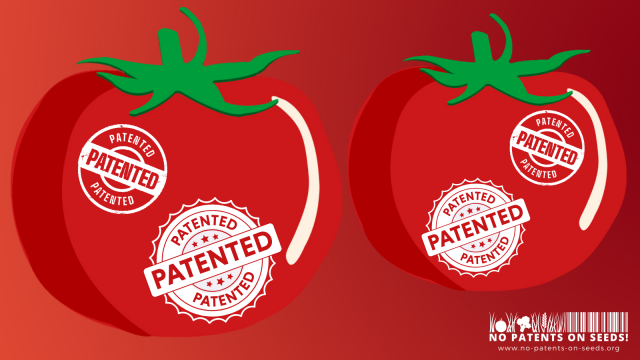 European patent law explicitly prohibits patents on the processes of crossing and selection as well as on the resulting plants. This prohibition was re-enforced and strengthened in 2017. At that time, the new rule 28 (2) was introduced on the initiative of the EU to specifically prohibit patents on plants resulting from crossing and selection.
The claims in this patent are worded and designed to circumvent the prohibition on plant patents: to avoid mentioning the words ‘crossing and selection’, plant breeding is instead described as ‘growing seeds to produce plants’. Basically, the patent claims all tomato plants that inherit the natural gene variants with resistance to the virus as obtained from crossing and selection with the wild tomato plants. This completely undermines the new rule.
Johanna Eckhardt from No Patents on Seeds! states: “Recent EPO decisions have essentially turned the EU initiative into a ‘paper tiger’. The EU actually wanted to stop the monopolisation of natural genetic resources and conventionally bred plants. If it now fails to react to the ongoing violation of these legal provisions, it will lose all credibility.”
Patents on plants with natural traits are a huge problem, especially for small and medium-sized traditional breeding companies, as they create high costs and legal uncertainties. In addition, patents create monopolies on the use of the claimed genetic resources. It is frequently the case that breeders can only gain access through very expensive licence contracts - this has already resulted in breeding projects being abandoned. A recent EU Commission report acknowledges that these problems exist. According to an industry-run database (Pinto), the patent will give the company control over access to 39 plant varieties that could otherwise be freely used for further breeding.
According to European laws, only genetically engineered plants can be technical inventions, and thus patentable. However, the EPO has in recent times continued to expand patentability to conventionally bred plants. New research shows that this tomato patent is not the only one. Examples of recently granted patents claiming naturally occurring genes include maize (EP3560330), spinach (EP3975697), tomatoes (EP3911147) and lettuce (EP3797582).
During the discussion on the future regulation of plants obtained from new genetic engineering (NGT), the EU Parliament proposed at minimum banning patents on conventional plant breeding and naturally occurring gene variants. However, these demands are no longer included in the draft compromise text negotiated in December 2025. Therefore, No Patents on Seeds! urges the EU Parliament to reject, or substantially amend, this proposal in order to enforce current prohibitions in patent law.
Contact
- Johanna Eckhardt, project coordination, No Patents on Seeds!, johanna.eckhardt@no-patents-on-seeds.org, + 43 680 2126 343
- Christoph Then, spokesperson No Patents on Seeds!, info@no-patents-on-seeds.org, +49 151 54638040
Further information
- Patent EP3720272 on the EPO website:
https://register.epo.org/application?lng=en&number=EP18814903
- More about tomato patents:
https://www.no-patents-on-seeds.org/en/jordan_virus
- The latest research report by No Patents on Seeds!:
https://www.no-patents-on-seeds.org/en/7-Patents-Report
- The PINTO database:
https://euroseeds.eu/pinto-patent-information-and-transparency-on-line/
- The study of the EU Commission:
---
You can share our posts about this press release on Facebook and X or share the direct link to this press release: https://www.no-patents-on-seeds.org/en/patent-law