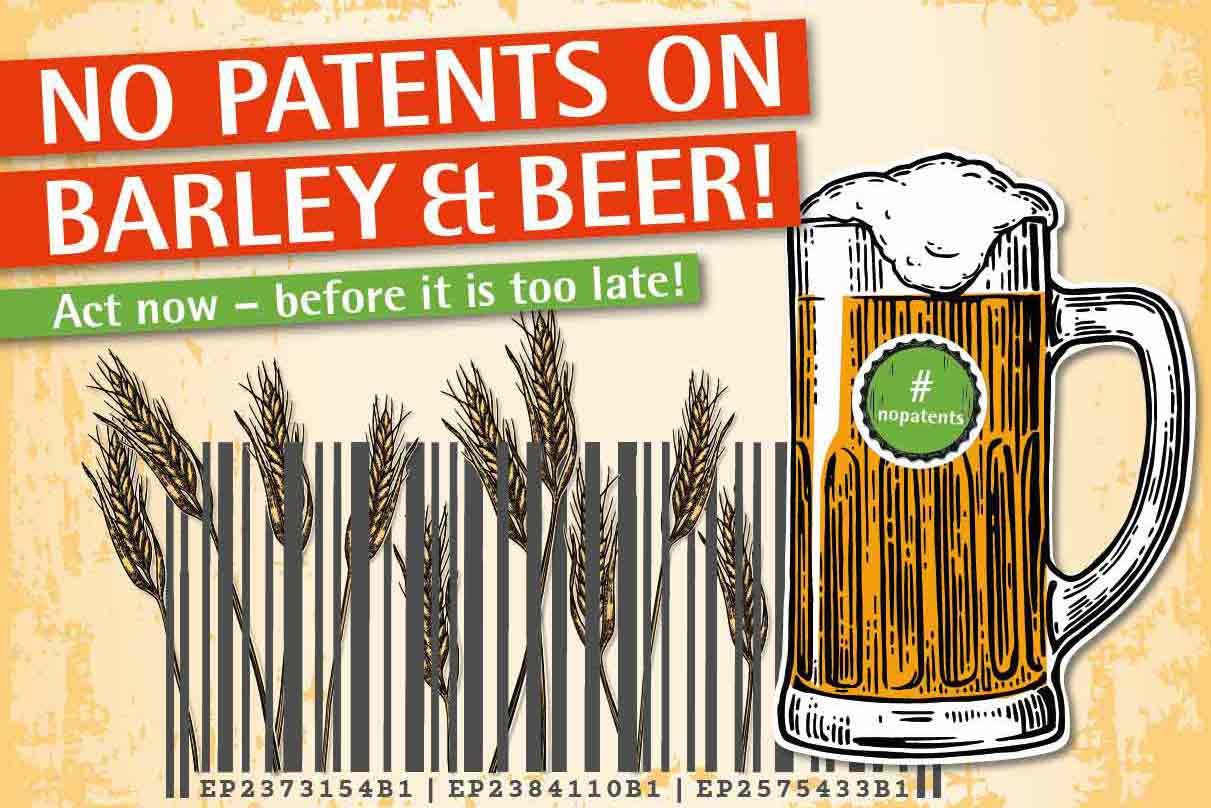
The organisations behind No Patents On Seeds are especially concerned about increasing number of patents on plants, seeds and farm animals and their impact on farmers, breeders, innovation and biodiversity. These patents create new dependencies for farmers, breeders, food producers and consumers. These patents have to be regarded as misappropriation of basic resources in farm and food production and as general abuse of patent law. We call for an urgent re-think of European patent law in biotechnology and plant breeding and to support clear regulations that exclude from patentability processes for breeding, genetic material, plants and animals and food derived thereof.
UPDATE: At today's hearing (see below) the EPO has decided that methods for the selection of sex in breeding of cows and the selected natural sperm are in principle considered as patentable inventions.
These kind of patents could greatly impact animal breeding and agriculture because artificial insemination is widely used in cattle and pig breeding. Other companies have likewise already applied for patents on breeding material and farm animals.
No final decision was taken on whether or not to uphold the patent finally has been taken. Another hearing in May next year will be needed to decide on inventiveness.
Today's decision is further proof that European patent laws urgently
need to be updated in order to explicitly exclude from patentability
plants and animals, genetic material and processes for breeding of
plants and animals and food derived thereof. The EPO constantly
interprets current vague language of patent law in such a way that existing prohibitions are circumvented. It is time for lawmakers to act. No Patents on Seeds calls on the European Parliament to take the initiative and call for a revision of EU directive 98/44.
Munich, 24.11.2011 – The European Patent Office (EPO) will today take a decision on a patent on animal breeding (EP1257168). XY LLC, a subsidiary of the US company Inguran LLC, is claiming a process to select the sex of offspring in animal breeding. For this purpose, the sperm cells are sorted by a technical device. The sperm selected through this process are then claimed as an invention. The patent could greatly impact animal breeding and agriculture because artificial insemination is widely used in cattle and pig breeding. Other companies have likewise already applied for patents on breeding material and farm animals. This patent might now become a precedent in animal breeding in the same way that the patents on broccoli and tomato were a precedent in plant breeding.
Patent on tomato becomes a landmark decision
Call for better control of EPO
Munich, 8 November 2011. Today the European Patent Office (EPO) decided to forward the patent on tomatoes (EP1211926) to the Enlarged Board of Appeal. In doing so the EPO surprisingly followed calls by critics who fundamentally oppose patents on plants and animals. This decision questions the office's current practice of granting patents on plants and animal derived through traditional breeding methods. The Enlarged Board of Appeal is theEPO's highest instance and will have to take a decission of principle on the patentability of plants and animals.
So far some 100 such patents have already been granted. Breeders, farmers, environmentalists, development and consumer organisations and even the German government have demanded the granting of these patents be stopped. The international coalition of No Patents on Seeds cautions against seeing today's decision as a final solution.
"Today the EPO put on the emergency break to prevent further damage to its own reputation," says Christoph Then, advisor on patents for Greenpeace and spokesperson for the No Patents on Seeds coalition. "This is an important success for all those who oppose patents on plants and animals. However, the public cannot trust the EPO. An institution that declares tomatoes, broccoli and melons to be inventions of industry undermines its own legitimacy. The EPO must be put under the control of independent courts and European governments, in order to prevent it from continuing to take biased decisions in the interests of the biotech industry. Furthermore we demand that European patent law is revised in such a way that patents on plants and animals are completely prohibited.",
The patent (EP 1211926) covers seeds, plants and tomatoes derived through traditional breeding. Tomatoes from the region of origin were combined with common varieties. As a result the tomatoes have a reduced water content, which makes them interesting for further food processing, such as for ketchup. The patent had been granted to the ministry of agriculture of the state of Israel, and was challenged by Unilever to protect its own commercial interests. In December 2010 the EPO's Enlarged Board of Appeal took the decision that traditional breeding methods in general cannot be patented. However, products derived through such methods remained patentable.
A number of patents on plants derived through traditional breeding methods have already been granted in the past to companies like Monsanto, Dupont, Bayer and Syngenta. Opponents warn that consumers, farmers and food producers will suffer new dependencies on these international companies. Farmers and consumers in developing countries are also affected as well as those in Europe.
During the past few years an international coalition including the organisations Berne Declaration, GeneWatch, Greenpeace, Le Réseau Semences Paysannes, Norwegian Development Fund, No Patents on Life!, Misereor and Swissaid has been campaigning against such patents (www.no-patents-on-seeds.org)
Contact: Christoph Then, Tel 0049 15154638040
Sign the letter.